
Multi-Flavor Vape Pod Electrode Pins: A Complete Technical Guide
One device, multiple pods, instant flavor switching—multi-flavor systems have become a major product direction in refillable vape devices. From early physical pod swapping to today’s rotating multi-pod mechanisms and 4-pin recognition designs, the multi-flavor vape pod electrode pins at the bottom of each pod have evolved from simple power contacts into precision components responsible for flavor identification, current delivery, and long-term durability.
This guide explains three things in one place: how multi-flavor pods “choose” a flavor, what role electrode pins play in those systems, and which parameters matter most when selecting or customizing them.
1. Two Main Technical Routes for Multi-Flavor Pods
Published vape-structure patents currently fall into two broad categories: rotating multi-pod mechanisms and 4-pin / multi-contact recognition.
Route A: Rotating Multi-Pod Mechanism
This is the most common patented approach. Several small pods—each filled with a different e-liquid flavor—are arranged in a circle. Each pod has contact electrodes distributed evenly around the circumference. By rotating a dial on the battery section, the user brings the target pod’s electrodes into contact with the battery’s power electrodes, activating that flavor.
Representative patents include Sigelei’s “replaceable-flavor e-cigarette” (CN221204134U, using multiple circumferential electrodes plus a spring-loaded positioning pin), CN118923949A, Dosen’s “replaceable-flavor e-cigarette structure” (CN222340570U), Li’an’s “multi-flavor switching e-cigarette” (CN222954868U), and Rehuo’s “multi-flavor switching e-cigarette” (CN222787070U).
This route places three demands on electrode pins: consistent rotary positioning, durability under repeated rotation, and reliable insulation between adjacent channels.
Route B: 4-Pin / Multi-Contact Recognition (Single Pod, Multiple Channels)
The other approach installs a common ground plus several independent power/signal channels at the bottom of one pod. The battery section identifies which flavor channel is active through the contact pattern. A well-known example is the 4-contact pod design used in products such as the Black Elite series, alongside patents such as Hanqingda’s four-pod combination patent (CN222888602U).
This route turns the electrode set from “two pins” into “four or more pins.” The extra contacts carry both current and flavor-recognition signals, raising the requirement to a true precision connector level: consistent spring force across all pins, pin-to-pin insulation, and reliable independent-channel conduction.
How the Two Routes Differ in Electrode Requirements
| Dimension | Rotating Multi-Pod | 4-Pin / Multi-Contact |
|---|---|---|
| Pin count | 2–4 pins per pod, circular layout | 3–6 pins concentrated at pod bottom |
| Main challenge | Rotary alignment and wear resistance | Multi-pin spring-force consistency and insulation |
| Insertion cycles | Frequent rotation, high cycle count | Pod insertion + channel switching, dual demand |
| Electrical demand | Power delivery with reliable switching | Power + signal recognition, anti-crosstalk |
| Corrosion resistance | E-liquid/condensate environment | More gaps and crevices, higher sealing concern |
2. The Upgraded Role of Electrode Pins in Multi-Flavor Systems
In conventional refillable pods, the electrode pin has one simple job: positive and negative pins deliver current to the heating element. In multi-flavor systems, it takes on more:
- Flavor identification channel: the battery must know which pod or channel is currently selected and energize only the corresponding heating unit—the extra contacts carry that recognition signal;
- Independent power loop: each flavor has its own power path, so current capacity and contact resistance directly affect雾化 stability;
- Long-life guarantee: rotating mechanisms subject the pins to repeated rotational contact, while refillable multi-flavor pods also face higher insertion/extraction cycles than single-flavor products.
In short, a multi-flavor pod electrode pin is essentially a precision electrical connector, not an ordinary turned-metal part. Its reliability determines whether flavor switching works smoothly, whether flavors cross-contaminate electrically, and how long the product lasts.
3. Key Parameters of Multi-Flavor Vape Pod Electrode Pins
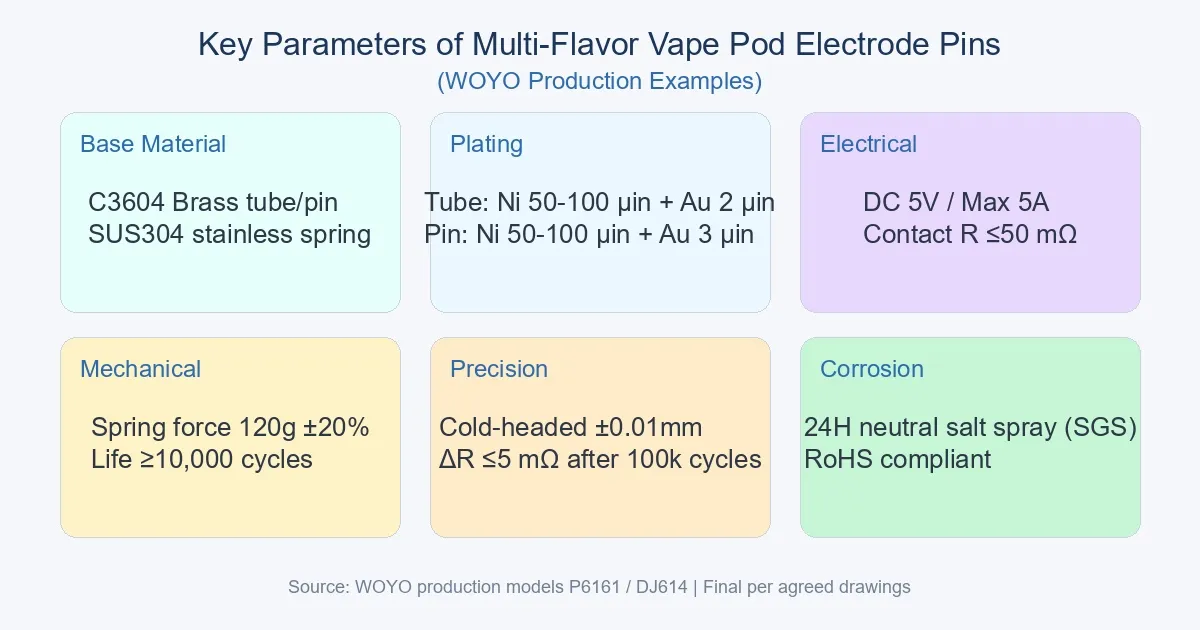
The table below lists the core parameters buyers and engineers usually care about, with examples from WOYO’s mass-produced vape electrode pins (P6161 Ailaimi-style, DJ614 Platypus-style, etc.):
| Parameter | Typical Industry Requirement | WOYO Mass-Production Example |
|---|---|---|
| Base material | Copper alloy body + stainless-steel spring | C3604 brass for barrel/plunger; SUS304 stainless spring |
| Plating | Nickel under-plate + gold top layer to block copper diffusion | Barrel: Ni 50–100U” + Au 2U”; plunger: Ni 50–100U” + Au 3U”; high-grade option: 1μm gold |
| Electrical | Lower contact resistance = more stable conduction | Contact resistance ≤50mΩ at working height (standard); high-grade cold-forged option: ΔR ≤5mΩ after 100,000 cycles |
| Current / voltage | Matched to atomizer power | DC 5V working voltage, max 5A current |
| Spring force | Customized for insertion feel and contact reliability | 120g±20% at working height (standard); 30–150g customizable |
| Insertion life | Ten-thousand cycles minimum | ≥10,000 cycles (standard); up to 100,000 cycles (high-grade) |
| Dimensional accuracy | Within ±0.05mm; tighter for multi-pin | High-grade cold-forged option: ±0.01mm, CMM 100% inspected |
| Corrosion resistance | Salt-spray validated for e-liquid/condensate | 24H neutral salt spray (SGS, GB/T 10125), no corrosion |
| Environmental compliance | Mandatory for export markets | RoHS certified, heavy-metal compliant |
Use this as a shortlist: base material for conductivity and strength, plating for corrosion and life, contact resistance for conduction efficiency, spring force for feel and reliability, tolerance for multi-pin consistency, and cycle life for long-term cost.
4. Four Critical Dimensions for Multi-Flavor Electrode Pin Selection
Multi-flavor systems magnify every electrode-pin issue across multiple pins. Keep these four dimensions in mind when specifying or customizing:
4.1 Multi-Pin Height Consistency
Whether the electrodes are arranged in a circle or clustered at the pod bottom, every pin in the same batch must have consistent assembled height and travel. Excessive height variation causes some channels to make poor contact or fail recognition. For multi-pin designs, height tolerance should typically be held to ±0.01–0.02mm, with 100% travel inspection.
4.2 Spring-Force Grouping
If the four pins do not share the same initial spring force, the user feels uneven insertion resistance and contact reliability varies. Experienced suppliers test every spring before assembly and group them by ±3g tolerance so that all pins in one set behave the same.
4.3 Plating and Corrosion Resistance
Complex e-liquid chemistry and condensate ingress are the leading causes of vape electrode failure. A nickel under-layer prevents copper diffusion, while the gold top-layer ensures low contact resistance and oxidation resistance. For highly corrosive e-liquids, palladium-nickel or rhodium finishes can be evaluated, validated by neutral salt-spray testing (e.g., 24H/48H).
4.4 Cycle Life and Contact-Resistance Drift
Frequent flavor switching means more insertion cycles. Ask for a life target in cycles (10,000 or 100,000) and verify the contact-resistance drift at end-of-life, not just the initial resistance value.
5. WOYO: A Precision Manufacturing Partner for Vape Electrode Pins
Shenzhen Shengyangtong Technology Co., Ltd. (WOYO) was founded in 2016 and is a high-tech enterprise integrating design, R&D, manufacturing, and sales of precision Pogo Pin connectors. Our main products include Pogo Pins, vape electrode pins, magnetic connectors, spring-contact connectors, precision turned parts, and custom interconnect assemblies, with full-process ODM services. We hold more than 40 patents and are certified to ISO9001 and ISO14001.
For multi-flavor vape pod electrode pins, WOYO offers:
- Standard compatibility: Ailaimi-style, Platypus-style, Kakuqi-style, Manniu PRO-style, and other proven mass-production specifications ready for selection;
- Multi-pin customization: 3- to 6-pin layouts, circular rotating arrangements, pitch and insulation design, with our engineering team involved early in your design phase;
- Spring-force and travel customization: tailored working force and travel to match your pod’s insertion feel and contact-reliability targets;
- Plating selection: compliant plating recommendations for different e-liquid chemistries and export regulations (RoHS/REACH, etc.);
- Full-process validation: high/low temperature, salt spray, insertion-life, and dynamic load-impedance testing, with 100% inspection of critical parameters before shipment.
From drawings to mass production, WOYO works on the principle of “same quality, lower total cost; stable delivery at volume.” We provide a reliable electrode-pin supply chain for vape brands and solution providers.
6. Frequently Asked Questions
Q1: How many electrode pins does a multi-flavor vape pod usually need?
It depends on the architecture. Rotating multi-pod designs typically use 2–4 pins per pod arranged in a circle; 4-pin/multi-contact recognition designs usually place 3–6 pins at the bottom of a single pod. The exact count is determined by the number of flavor channels and the electrical design.
Q2: What contact resistance is considered acceptable for vape pod electrode pins?
Industry practice is ≤50mΩ at working height, and multi-pin designs should also minimize pin-to-pin variation. For high-power or frequently switched products, also check the resistance drift at end-of-life rather than only the initial value.
Q3: Can e-liquid corrode electrode pins?
Yes. E-liquid and condensate contact are leading causes of vape electrode failure. That is why electrode pins typically use nickel under-plating plus gold top-plating and are validated by neutral salt-spray tests (e.g., 24H/48H per GB/T 10125). For highly aggressive e-liquids, palladium-nickel or rhodium finishes can be considered.
Q4: Can multi-flavor vape pod electrode pins be customized? How long does sampling take?
Yes. Pin diameter, length, spring force, plating, and plunger tip shape can all be customized. WOYO offers 48-hour rapid sampling and mass production in as fast as 20 days, with engineering support from the early structural-design stage to help avoid assembly and insulation risks.
Q5: What insertion life should I expect?
Standard vape electrode pins are typically rated for at least 10,000 cycles. Because multi-flavor products are switched more often, we recommend specifying 10,000+ cycles; high-grade cold-forged designs can reach 100,000 cycles with contact-resistance change ≤5mΩ.