
AI Glasses Magnetic Charging Solution Selection Guide: Pogo Pin Parameters & Customization | WOYO
AI Glasses Magnetic Charging Solution Selection Guide: Pogo Pin Parameters, Customization & Mass Production
In 2026, China’s smart glasses shipments are projected to exceed 4.508 million units, up 77.7% year-over-year. But another set of numbers tells a less flattering story: return rates on major e-commerce platforms hover around 30%, with some models reaching 40–50%—and charging interfaces and battery life are the top complaint categories.
If your team is evaluating an AI glasses magnetic charging solution, this guide was written for you. We won’t waste time explaining “why magnetic”—that’s common knowledge by now. This guide answers four questions only: how to determine pin count, magnetic strength rating, IP protection level, and whether a supplier can deliver a reliable prototype within 72 hours. We’ve included a parameter quick-reference table and a complete customization workflow at the end so engineers and procurement teams can put it to use immediately.
For a full product overview, visit our AI Glasses POGOPIN Magnetic Charging Solution page for complete specifications and technical details.
Key Takeaways
- IDC projects 4.508 million smart glasses in China in 2026 (+77.7% YoY); Omdia forecasts global AI glasses will surpass 10 million units for the first time. Charging interface reliability has become the dividing line between repeat purchases and returns.
- Pogo Pin magnetic charging is already mainstream for mid-to-high-end products: Ray-Ban Meta V3 Slim uses 18-pin magnetic data cables for combined charging + data + control; Xiaomi MIJIA Audio Glasses 2 takes a 2PIN minimalist fast-charging route—both confirm one thing: smaller interfaces win.
- A solid AI glasses magnetic charging solution comes down to 4 hard parameters: pin count (2–18 PIN), magnetic strength (500G–1000G), gold-plated contacts (Au5u), and protection level (IPX4/IP67, –40°C~85°C wide temperature range).
- Supplier evaluation comes down to 4 delivery metrics: 72-hour prototyping, 7-day sample delivery, >99% on-time delivery rate, 100% outgoing inspection—the lowest unit price does not equal the lowest total cost.
1. Why Do Most AI Glasses Use Magnetic Charging? 4 Reasons Pogo Pin Has Become Mainstream
Space & Lightweight Design
The thinnest point on a temple is just 5mm—that’s the temple thickness of Xiaomi MIJIA Audio Glasses 2. In that space you need to fit speakers, microphones, battery, and charging contacts, leaving almost zero room for an interface. A Pogo Pin spring contact is only a few millimeters long and can be fully recessed inside the temple or frame, exposing only a flush contact surface. By comparison, a Type-C female connector occupies at least 6–7mm of thickness plus PCB area—effectively killing any lightweight design ambition.
Sweat & Water Resistance
Sweat corrosion is the #1 cause of charging failure. Glasses sit against skin; an hour of summer exercise produces enough sweat to seep into ordinary connectors. Magnetic interfaces achieve IPX4 or even IP67 through sealed structures, with gold-plated contacts that resist corrosion—wipe it off and keep going. For commuting and sports use cases, this is essentially non-negotiable.
Insertion Life & Reliability
Type-C insertion life typically tops out around 10,000 cycles, and every insertion causes physical wear. Magnetic charging eliminates the “insert” action entirely—one touch and it snaps on. The industry standard range is 10,000–100,000 insertion cycles, with 10,000 as the baseline guarantee and higher specs achievable through material and structural optimization. More critically, there’s a safety mechanism: when pulled, the magnetic connection releases automatically, preventing damage to the glasses body—something Type-C cannot do. For those seeking longer life or alternative contact structures, check out our spring contact connector solutions, which follow the same elastic-contact principle.
User Experience & Integrated Aesthetics
Charging in the dark, single-handed operation, topping up while still wearing them—magnetic’s “snap-on” nature is naturally suited for blind operation. Visually, the interface disappears completely; no large cutouts needed in the temples, for a cleaner overall design. Magnetic has effectively locked in as the choice for mid-to-high-end models.
We encountered exactly this scenario last June. An hardware engineer at a Shenzhen-based AI glasses brand ordered 100 sets of magnetic charging contact samples from a supplier who verbally promised “samples in a week.” Two weeks later they arrived—and once installed in the temple, contact resistance had spiked from the spec’d 30mΩ all the way to 200mΩ. After 10 minutes of charging it was hot enough to require a full redesign, pushing the project back a month. He switched to a supplier offering 72-hour prototyping, received new samples in three days, and locked the design in a week. “Fast prototyping means mature processes—they’re not using our order to practice,” he told us.
2. Market Explosion: Smart Glasses Shipment Data & Charging Solution Trends
IDC/Omdia Key Forecasts
Put these numbers together and the trend is clear (sources: IDC, Omdia public forecasts):
- IDC: Global smart glasses shipments projected to reach 23.687 million units in 2026, including 4.508 million in China (+77.7% YoY) (IDC official press release);
- Omdia: Global AI glasses shipments to hit 10 million for the first time in 2026 (+97% YoY), reaching 35 million by 2030, CAGR 47% from 2025–2030 (Omdia official press release);
- IDC: Global smart glasses to surpass 40 million units by 2029, CAGR 55.6% from 2024–2029 (Securities Daily report).
Another detail matters equally: IDC expects non-full-color displays to account for 85% of 2026 shipments, with sub-50g products exceeding 45%. As more lightweight products enter the market, interface volume becomes increasingly sensitive—this is precisely where pogo pin magnetic charging finds its opportunity. WOYO keeps updating Pogo Pin industry trends and real case studies—worth following.
From “Hundred-Glasses War” to “Charging Experience Determines Repeat Purchase”
2025 was dubbed the “Year of AI Glasses.” Amidst the hundred-glasses battle, brands competed fiercely on optics and AI features—but return rates remained stubbornly high at around 30% on major platforms, hitting 40–50% for some models. Customers discovered: charging is inconvenient, battery life causes anxiety, and interfaces fail easily. The charging experience has shifted from a “detail” to the first touchpoint—whoever nails charging first suppresses negative reviews.
3. Four Charging Solutions Compared: Type-C vs. PogoPin Magnetic vs. Charging Case vs. Wireless
Here’s the bottom line upfront: compare Type-C, Pogo Pin magnetic, charging case, and wireless side-by-side, and the answer for mid-to-high-end models leaves almost no room for debate. Share the table below directly with your product manager.
One-sentence verdict: For mid-to-high-end AI glasses, Pogo Pin magnetic charging is the near-universal choice.
| Solution | Size / Weight | Sweat/Water Resist | Cycle Life | User Experience | Cost | Typical Example |
|---|---|---|---|---|---|---|
| Type-C Direct | Poor (requires large opening) | Poor (seepage risk) | Moderate (~10k cycles) | Average (alignment required) | Lowest | Early products |
| Pogo Pin Magnetic | Excellent (flush-mounted) | Excellent (IPX4–IP67) | Excellent (10k–100k) | Excellent (snap-on, blind-friendly) | Medium | Ray-Ban, Xiaomi |
| Charging Case (dock-to-charge) | Excellent (no exposed interface) | Excellent | Excellent | Excellent (but must carry case) | Highest | Ray-Ban V3 Case |
| Wireless Charging | Moderate (coil + PMIC needed) | Moderate | Excellent | Excellent | High | Early concept models |
Why “Charging + Data Combined Magnetic” Is the Mid-to-High-End Favorite
The table makes it obvious: Type-C loses on size and waterproofing; wireless is slow and runs hot; charging cases are expensive and model-specific. Pogo Pin magnetic strikes the best balance across size, protection, life cycle, and cost—and can be extended into a “charging + data + control signal” composite interface. That’s its killer differentiator versus every other option. For a deeper side-by-side comparison, see our AI Glasses Charging Solutions Ultimate Comparison.
4. Core Parameters & Selection Guide for AI Glasses Magnetic Charging (Engineer Must-Read)
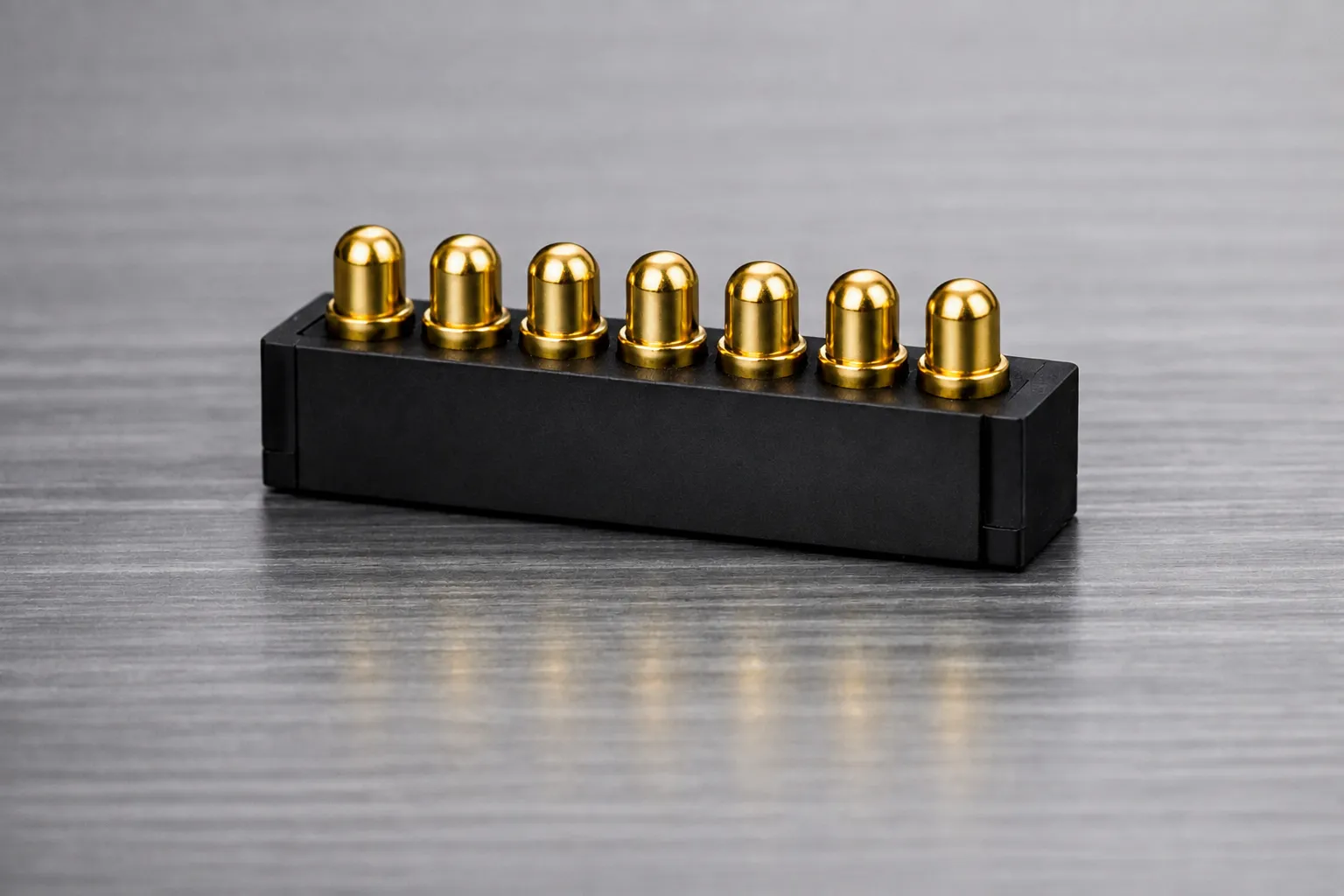
Pogo Pin spring contact gold-plated real product shot — the precision foundation of every magnetic charging solution.
This section is written for engineers: the core parameters of an AI glasses magnetic charging solution boil down to five—pin count, magnetic strength, contact plating, protection level, and fast-charge protocol. Let’s break each one down.
Pin Count & Function: How to Choose Between 2PIN and 18PIN
Pin count is driven by function—not more is better.
- 2PIN: Charge only. Suitable for audio glasses and notification glasses with low power draw. Xiaomi MIJIA Audio Glasses 2 is the classic example;
- 4–8PIN: Charge + basic data. Supports firmware updates and parameter configuration. Fits products with camera or recording features;
- 10PIN+: Charge + high-speed data + control signals composite. For AR/XR flagships needing video, sensor, and power composite transmission. Ray-Ban Meta V3 Slim uses 18pin.
Rule of thumb: fewer pins = lower cost and higher reliability. When adding functions, prioritize isolation between charge and data paths to avoid crosstalk.
Magnetic Strength 500G–1000G: Balancing Retention Force vs. Ease of Removal
Too weak and it disconnects during charging; too strong and removing the cable becomes difficult—it may also interfere with magnetometers and other sensors. Industry-standard tiers:
- 500G–600G: Lightweight audio glasses, sufficient for daily wear;
- 700G–800G: Mainstream AI camera glasses, balancing retention and ease of removal (Ray-Ban V3 Slim magnetic cable measures ~800G);
- 900G–1000G: Scenarios requiring stronger retention, such as sports flagship models.
During selection, also verify magnet impact on sensors—for example, compass drift from magnetic interference or accidental adhesion to metal objects on desks. Both should be ruled out during structural review.
Contact Plating: Au5u Gold & Contact Impedance
Contact plating directly determines impedance and corrosion resistance. The industry-standard gold plating is Au5u (5 microinches thickness). Leading manufacturers typically hold contact impedance under 50mΩ (premium solutions achieve ≤10mΩ), striking a balance between low resistance and high corrosion resistance. Lower impedance means lower charging loss and less heat generation. When evaluating suppliers, request three data points: plating composition, gold thickness, and measured contact impedance. WOYO publishes the full specification range on our spring contact connector product series page for direct comparison.
Waterproofing & Wide Temperature: IPX4/IP67, –40°C~85°C
Protection level should match usage scenario:
- IPX4: Splash-resistant, sufficient for daily commute and light exercise—currently the mainstream default;
- IP67: Short-term immersion and dust-proof, suitable for outdoor and sports flagships.
Temperature range matters equally. High-temperature outdoor use and winter cold environments both affect springs and seals. A –40°C~85°C wide-temperature design covers more extreme scenarios and significantly reduces after-sales risk.
Insertion Life & Fast-Charge Protocol: 10,000+ Cycles, PD3.0/QC4.0
Magnetic interface life depends on spring contact fatigue strength. The mainstream range is 10k–100k cycles, with 10k as the baseline guarantee and higher specs customizable. On fast-charge protocol, magnetic solutions supporting PD3.0/QC4.0 deliver 30–40% efficiency gains over conventional approaches—”charge 10 minutes, use for hours” is made possible by this. Protocol compatibility also determines whether users can charge with third-party adapters.
One-line conclusion: Align pin count with function, magnetic strength with scenario, plating with life cycle, protection with environment.
| Parameter | Recommended Range | Notes |
|---|---|---|
| Pin count | 2PIN–18PIN | 2PIN charge-only; 4–8PIN +data; 10PIN+ composite |
| Magnetic strength | 500G–1000G | Audio 500–600G; mainstream 700–800G; sports 900–1000G |
| Contact plating | Au5u gold | Contact impedance <50mΩ, reduces charging loss |
| Protection level | IPX4 (mainstream) / IP67 (flagship) | Select per use case |
| Operating temp | –40°C~85°C | Covers outdoor and extreme environments |
| Insertion life | ≥10k cycles (customizable to 100k) | Determined by spring fatigue strength |
| Fast-charge protocol | PD3.0 / QC4.0 | 30–40% efficiency gain over conventional |
Engineer’s Cheat Sheet
- Align pin count to function—don’t over-spec unless your product genuinely needs it.
- Align magnetic strength to scenario—700–800G is the sweet spot for mainstream AI camera glasses.
- Au5u plating + measured contact impedance = hard metric for judging contact quality.
- Ask explicitly: IPX4 or IP67? What’s the operating temperature range? Don’t rely on nominal ratings alone.
Unsure about parameters? Send your mechanical drawing to WOYO engineers and get a prototyping plan within 72 hours. For a complete customization methodology, read Why Pogo Pin Customization Goes Wrong: 5 Design Details Every Engineer Must Know.
5. Three Typical Implementation Approaches: Temple-Mounted / Charging Case / Frame-Embedded
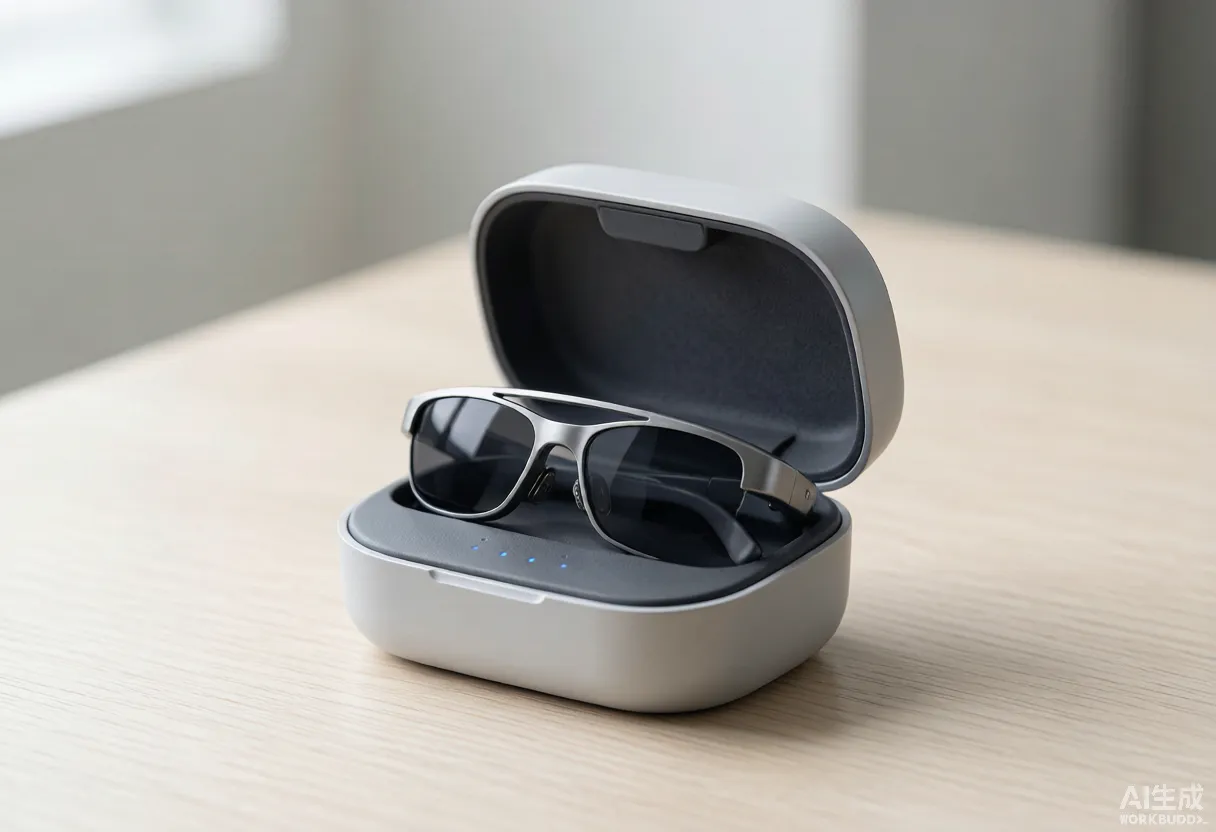
Smart glasses dock-to-charge case: place glasses in the case and magnetic contacts connect automatically—no manual alignment required.
Once parameters are set, implementation approach is next. Three mainstream options exist, ranked by structural complexity from low to high:
Temple-Mounted Magnetic Charging
Contacts placed at the temple tip; magnetic cable snaps on. Simple structure, controllable cost—this is the most common approach. Xiaomi MIJIA Audio Glasses 2 uses a cable with Type-C on one end splitting into two magnetic interfaces (two contacts each)—one-cable-to-two design charges both left and right temples.
Smart Glasses Dock-to-Charge Case
Contacts built into the glasses case; placing glasses inside initiates charging automatically. Ideal for “top-up anytime” products. Ray-Ban Meta V3 Slim charging case follows this approach. Downsides: higher case cost, model-specific fit—suitable for mid-to-high-end positioning only.
Frame-Embedded & Modular Extension
Contacts embedded at frame hinge points or detachable modules, enabling future battery/sensor upgrades via modular design. Best suited for flagships with extensibility roadmaps. Which approach fits depends on product positioning, structural space, and budget—we recommend involving your connector supplier during early-stage structural review.
6. Real Cases: Ray-Ban V3 Slim 18pin vs. Xiaomi MIJIA Audio Glasses 2 2PIN Fast-Charging
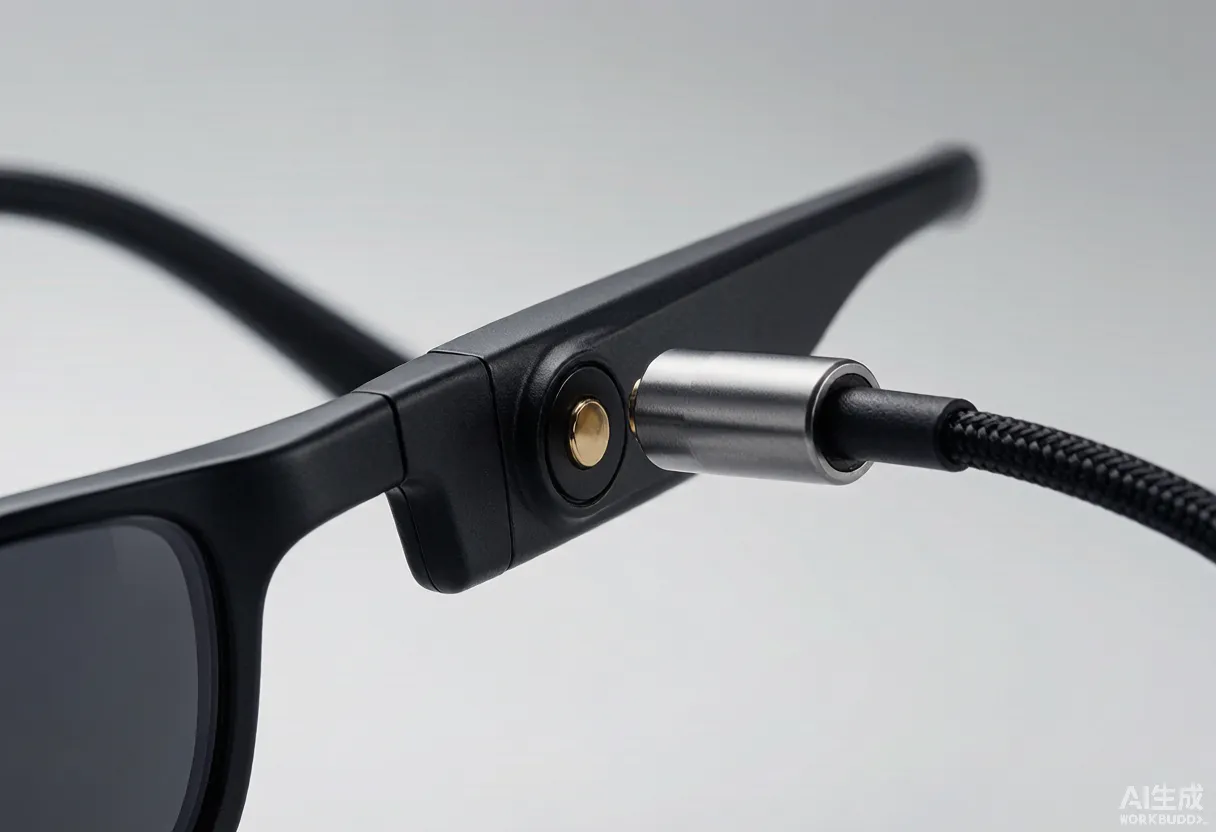
Temple-tip Pogo Pin gold-plated magnetic charging contacts (2pin/4pin/18pin fully customizable) — snap-on, blind-operation friendly. Both Ray-Ban and Xiaomi follow this architecture.
Two Paths: “Multi-Pin Composite Transmission” vs. “Minimalist Fast-Charging”
Ray-Ban Meta V3 Slim adopts an 18pin POGOPIN magnetic data cable. Those 18 pins aren’t just for charging—they simultaneously transmit data and firmware upgrade signals. For an AI camera glasses product, that bandwidth is necessary. Xiaomi MIJIA Audio Glasses 2 takes the exact opposite path: 2PIN magnetic fast-charging, delivering 4 hours of listening from a 10-minute charge while driving cost and reliability to the extreme.
Both paths illustrate the same principle: an AI glasses magnetic charging solution must align with product functionality, not blindly copy competitors. Audio glasses don’t need 18pin; AR flagships can’t survive on 2pin alone.
The procurement-side pitfalls are equally real. Last Q3, a procurement manager at one brand compared three suppliers’ 2PIN magnetic solutions side-by-side. Supplier A quoted lowest—at 0.10 RMB/unit, 15% cheaper than Supplier B’s 0.118 RMB. She chose A. Just before mass production, A notified her: “tooling schedule tight, delivery delayed three weeks.” Launch date was locked. She had to pay a rush premium to B for slot insertion—air freight and expedite fees alone cost 80,000 RMB. “The savings per unit didn’t even cover the rounding error on the total.” She moved delivery timeliness to the top of her supplier evaluation criteria afterward.
7. From Selection to Mass Production: B2B Customization Development
Five-Step Customization Workflow: Requirements → Prototype → Validation → Pilot → Mass Production
A well-structured AI glasses magnetic charging solution follows this pogo pin customization workflow:
- Requirements confirmation: Submit mechanical drawings, pin count, current rating, travel distance, protection requirements;
- Prototyping: Supplier delivers samples and spec sheet (mature suppliers: 72-hour turnaround);
- Validation: Install-test contact impedance, thermal rise, life cycle, waterproofing;
- Pilot production
- Mass production: Lock process parameters, enter volume delivery.
Document every step—especially measured data from the prototyping phase. It becomes your baseline for mass production.
Lead Time & Response: 72h Prototyping, 7-Day Samples, >99% On-Time Rate
For hardware teams, lead time is lifeline. Write these three numbers into your supplier contract: 72-hour rapid prototyping, 7-day sample delivery, annual on-time delivery rate >99%. Suppliers meeting all three have mature process lines and strong scheduling capacity—they won’t treat your project as a training ground. Shenzhen Shengyangtong Technology Co., Ltd. (WOYO) was founded in 2016 in Bao’an, Shenzhen—a national-level high-tech enterprise specializing in Pogo Pin spring contact R&D and manufacturing. These metrics are publicly committed on our WOYO qualifications & delivery commitments page, not verbal promises.
Quality Control: 100% Outgoing Inspection
Connectors are “one-vote veto” components—a few bad contacts in a batch can blow up after-sales service across thousands of units. Evaluate your supplier’s QC system: 100% outgoing inspection, DQE→SQE→PQE→CQE closed-loop QA, imported precision test equipment. 100% inspection is not spot-checking—put that in the contract.
Total Cost Perspective: Optimal Total Cost vs. Lowest Unit Price
Connector unit price is a small share of total BOM, but the after-sales cost it triggers can be enormous. A 0.02 RMB per-unit difference may buy you a 5% return rate. Calculate total cost properly: unit price + prototyping cost + delivery risk + after-sales cost. Truly excellent suppliers help you drive down total cost, not just push unit price to the floor.
Supplier Evaluation Scorecard (procurement teams can copy directly)
- Prototyping speed: 72-hour rapid turnaround indicates mature process lines.
- Sample delivery: 7-day delivery—don’t accept “about two weeks.”
- On-time delivery: Annual rate >99%, written into contract.
- QC method: 100% outgoing inspection + closed-loop QA system, not spot-checking.
8. FAQ: Common Questions About AI Glasses Magnetic Charging Solutions
Four frequently asked questions from engineers and procurement teams—all common pitfalls during AI glasses magnetic charging solution deployment.
What magnetic strength is appropriate?
Match to product scenario: 500–600G for lightweight audio glasses, 700–800G recommended for AI camera glasses, 900–1000G for sports flagships. Always verify magnets won’t interfere with nearby magnetometers or other sensors.
Can multi-pin support simultaneous charging and data transfer?
Yes. 4-pin and above supports concurrent charging and data/control signal transmission. Premium AR glasses even use 18pin for video, sensor, and power composite transmission. Prerequisite: pin pitch, impedance, and signal integrity must be properly designed—involve your supplier during design review.
Will sweat corrode the contacts?
It can—but if contacts are gold-plated (Au5u or better) and the interface achieves IPX4 or above, sweat corrosion impact becomes negligible. Key factors: plating thickness and seal structure. Don’t rely on nominal IP rating alone.
How long does prototyping take? Can you do small batches?
Mature suppliers deliver prototypes in 72 hours and samples in 7 days. Small batches (hundreds to a few thousand) are generally supported, though lead time and unit price may be slightly higher than volume orders. Confirm MOQ and delivery window during requirements phase.
9. Conclusion & Next Steps
The data speaks for itself—4.5 million units growing, 30% return rates waiting. Get the selection right and you ride growth; get it wrong and you absorb returns. Whether your AI glasses magnetic charging solution is well-chosen directly determines if your product earns “repeat purchase” or “return.” Remember four selection keywords: align pin count to function, magnetic strength to scenario, plating to lifecycle, protection to environment. And four supplier metrics: 72-hour prototyping, 7-day samples, >99% on-time rate, 100% inspection.
If you’re an engineer, send your mechanical drawing to your supplier for a structural review—it’s far more efficient than iterating ten designs in isolation. If you’re in procurement, write delivery terms and 100% inspection into contracts—it’s far more reliable than saving 0.02 RMB per unit. When searching for a pogo pin connector custom manufacturer or magnetic charging customization partner, run through the parameter quick-reference table and supplier scorecard before discussing price.
Shenzhen Shengyangtong Technology Co., Ltd. (WOYO) specializes in Pogo Pin spring contact connectors. Founded in 2016 in Bao’an, Shenzhen, we are a national-level high-tech enterprise serving leading brands including Ray-Ban Meta and Xiaomi. To verify our prototyping speed, initiate a magnetic charging customization / pogo pin connector customization (free prototyping) request—submit your temple mechanical drawing through the website form and receive a prototyping plan with confirmed parameters within 72 hours. We let our samples speak for themselves.