
What Black E-Cigarettes Teach Us About 4-Pin Pods: Why Your Pogo Pin Supplier Matters More Than You Think
If you follow the Southeast Asian e-cigarette market, you have probably heard of Black. From the Black Elite V1 to V2, this Philippine brand has carved out a differentiated path in the pod system segment with its “one device, multiple flavors” product logic.
The most interesting design detail is hidden at the bottom of the pod: four electrode contacts, not the industry-standard two.
Those two extra pins are the hardware foundation behind Black’s multi-flavor switching experience — and the core topic of this article. As e-cigarettes evolve from single-flavor to multi-flavor systems, the humble pogo pin connector is becoming a critical factor that determines both user experience and mass production cost.
1. Two-Pin vs Four-Pin: What Are Those Extra Contacts Actually Doing?
Traditional pod-system e-cigarettes typically have just two electrodes at the pod base: one positive, one negative. Their job is simple — deliver current from the battery to the heating coil. Power on, heat up; pull out, shut off.
But multi-flavor pods like Black’s operate on a fundamentally different principle. Based on publicly disclosed multi-flavor e-cigarette patents (e.g., Shenzhen Hanqingda Technology’s four-cartridge combination patent CN222888602U, Zhijian Forest’s dual-flavor switchable patent, etc.), multi-flavor systems need to transmit more information between the device body and the pod:
Two-pin: Positive + Negative → Pure power delivery, single flavor
Four-pin: Common ground + 3 independent power/signal channels → Supports 4 flavors with independent identification and switching
In essence, a four-pin design is an electrical interface upgrade — the connector must simultaneously handle power delivery and signal transmission. The device needs to know which flavor the user has rotated to, then energize only the corresponding heating element. Those extra contacts carry flavor identification signals and independent power channels.
For e-cigarette brands and manufacturers, this raises the bar for pogo pin connectors from “it conducts, good enough” to “precision electrical connector” level. The challenges that follow span several dimensions:
| Challenge | Two-Pin Era | Four-Pin Era |
|---|---|---|
| Spatial Layout | Two pins, generous spacing | Four pins squeezed into the same pod base — pin pitch shrinks by 50%+ |
| Contact Consistency | Small variance between two pins is tolerable | All four pins must have uniform spring force, travel distance, and contact resistance — or certain flavor channels will suffer intermittent connectivity |
| Electrical Isolation | Barely a consideration | Reliable insulation required between all four pins to prevent cross-channel shorts and flavor-switching errors |
| Durability | Standard insertion life is sufficient | Multi-flavor users rotate frequently — insertion cycles may increase 3-5x, demanding superior plating wear resistance |
| Corrosion Resistance | Basic requirements | Complex e-liquid chemistry + more crevices in a 4-pin structure = higher condensation ingress risk |
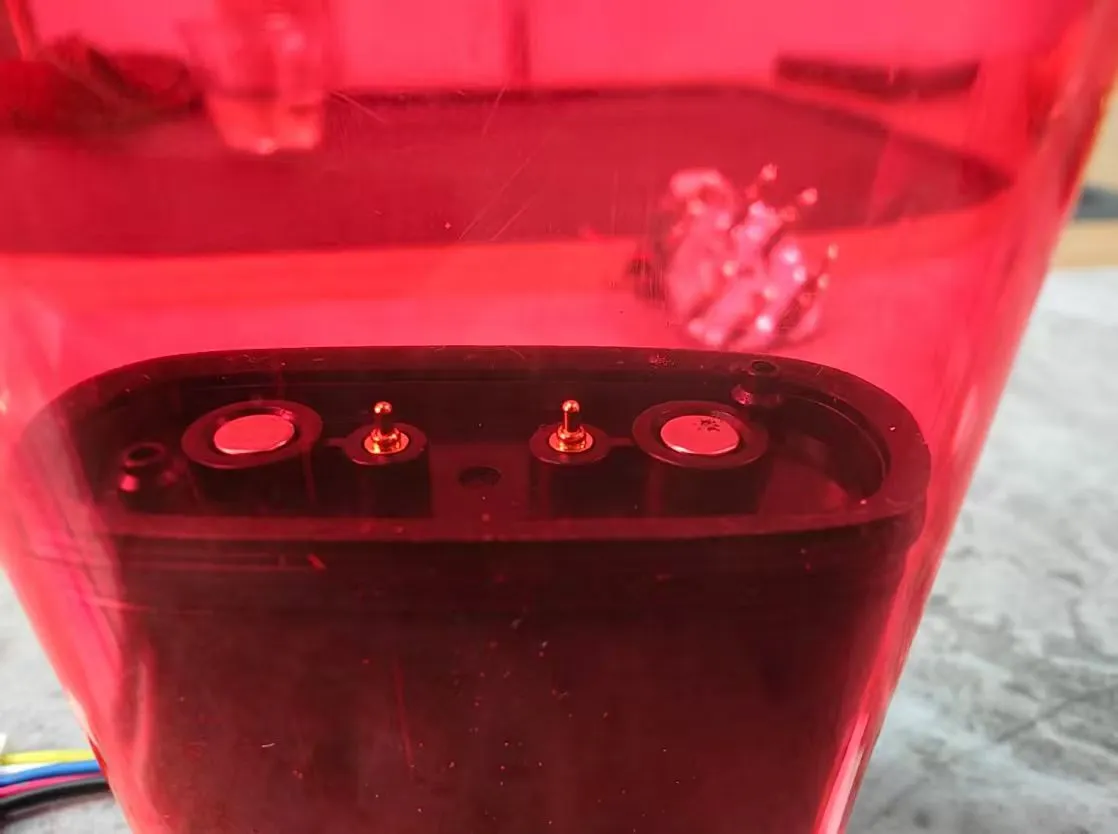
▲ Black pod base: two magnetic contacts (doubling as electrodes) + two independent pogo pins — the four-pin architecture enables independent signal channels for multi-flavor switching
2. The Underrated Reality: Pogo Pins Determine Pod Production Yield
There is an unwritten rule in the e-cigarette industry: the more structurally complex a small component is, the more likely it becomes a production yield bottleneck.
During pod assembly, pogo pin installation tends to be one of the least automated steps. If pin dimensional tolerances are not tightly controlled — say, tip height deviation exceeds ±0.05mm — contact failures will appear during PCB soldering or press-fit assembly. A four-pin design amplifies this risk because you need all four pins, not just two, to simultaneously meet tolerance requirements.
Here are real cases we have observed across the industry:
- Case 1: A brand’s first trial run of four-pin pods saw roughly 8% of units fail with “flavor unrecognized” errors. Root cause: the spring-loaded pin supplier had excessive travel tolerance, causing inconsistent actual contact heights after assembly.
- Case 2: A pod-system product received numerous “flavor mixing” complaints after launch. Investigation revealed insufficient insulation barrier margins between pins — e-liquid condensation seeped in, creating weak conductive paths that tricked the control board into misidentifying the selected flavor.
- Case 3: An export batch of multi-flavor pods, after maritime shipping through high-humidity and high-temperature conditions, showed oxidation spots on electrode surfaces. Contact resistance jumped from sub-30mOhm to over 200mOhm, with the defect rate exceeding 5% upon arrival.
The common thread in all these cases: the design was not the problem — the supply chain execution was. And the manufacturing capability of your pogo pin supplier directly determines whether these risks can be controlled.
3. Woyo’s Approach: Treating Pogo Pins as Precision Connectors, Not Commodity Hardware
Shenzhen Woyo Technology Co., Ltd., established in 2016, has positioned itself from day one as a Pogo Pin precision connector manufacturer — not a generic metal turning shop.
This positioning defines the gulf in production process and quality control standards:
3.1 Materials: Controlling Conductivity and Corrosion Resistance from the Source
E-cigarette pogo pins live in an environment of e-liquid and condensation. Material selection directly determines service life. Woyo uses:
- Copper alloy substrates (C3604 brass / C5191 phosphor bronze) — resistivity controlled below 0.07 Ohm per mm2 per m
- Multi-layer plating: nickel undercoat (anti-copper-diffusion) + gold top coat (Au 99.9%, thickness at least 0.25um) — contact resistance stable at under 30mOhm
- For high-corrosivity e-liquid formulations, optional palladium-nickel or rhodium plating — salt spray tested 48 hours with zero corrosion points
3.2 Precision: How Four-Pin Consistency Is Achieved
Four-pin solutions are particularly demanding when it comes to tip height uniformity. Woyo’s approach:
- Full CNC turning: All three core components — plunger, barrel, and spring — are produced in-house on automated CNC lathes. Single-setup machining ensures concentricity.
- Spring force batch sorting: Every spring undergoes force testing before assembly, sorted into +/-3g tolerance groups to guarantee uniform initial force across all four pins in a batch.
- 100% travel testing: Post-assembly, every single unit is tested for full-travel contact resistance to screen out travel anomalies.
3.3 Customization: Not “take what is available,” but “build what you need”
Woyo’s R&D team engages deeply during the client’s early design phase. For multi-flavor pod electrodes, we can assist with:
- Pin layout optimization: Arranging 4 pins within limited space while balancing insulation clearance and assembly feasibility
- Spring force customization: Tailoring working force from 30g to 150g based on the pod structure’s insertion/retention feel requirements
- Plunger tip selection: Flat / round / serrated / crown tips — matched to PCB pad or contact plate configurations
- Specialty plating: RoHS / REACH / TPD-compliant plating for different export markets
⚙️ Case Study: Four-Flavor Pod Electrode Solution for a Major Brand
Requirement: 4 pogo pins within a 12mm-diameter circular area at the pod base, supporting independent 4-flavor power switching, rated for at least 5,000 insertion cycles.
Woyo Solution:
- 4 x 1.5mm-diameter micro pogo pins, 2.8mm pin pitch, inter-pin insulation resistance at least 100MOhm
- Common ground pin rated 2.0A high-current design; remaining 3 signal pins at 0.5A
- Custom 60 +/-5g working force — balancing insertion feel with contact reliability
- 48-hour sample delivery; 5,000-cycle insertion life validation completed within 2 weeks
- Post-launch production yield at least 99.5%; unit cost reduced ~18% vs client’s previous solution
4. Quality and Cost: Not an Either/Or Tradeoff
A common misconception in the industry: “If you want quality, accept a higher price. If you want cost control, sacrifice quality.” Woyo does not buy this logic.
Real cost control comes from process optimization and economies of scale — not from cutting corners.
How does Woyo help clients save money without compromising quality?
- Reduce trial-and-error costs: R&D team intervenes during the client’s design phase, preempting structural risks through simulation and empirical data. A single pin-layout adjustment suggestion could save the client two rounds of mold costs.
- Scale-driven cost dilution: With 8 million pcs/month capacity, raw material procurement pricing and unit production cost both benefit from scale — and those advantages are reflected in the quotes we give clients.
- Stable yield reduces waste: Full-process quality control (incoming IQC -> in-process IPQC -> outgoing OQC) with 100% inspection on critical parameters. Consistent yield means fewer defective units for the client, lower production-line downtime risk, and reduced after-sales costs.
- No over-engineering: Not every product needs military-grade specs. Woyo engineers recommend appropriate materials and processes based on the client’s actual usage scenarios — so you do not pay for performance you will never use.
5. Closing Thoughts
Black’s four-pin pod design exemplifies an industry trend in motion: e-cigarette products are moving from the “good enough to vape” era into a phase of experience-driven, precision competition. Multi-flavor, high power, fast charging, smart displays — every feature upgrade raises the performance bar for connector components.
A pogo pin may be a sub-dollar component, but it sits at the very front of the current path — it is the sole electrical bridge between pod and device. If it fails, the best atomizer coil, the most precise temperature control algorithm, and the most beautiful industrial design all become irrelevant.
Choosing a supplier who truly understands the e-cigarette industry and treats pogo pins as precision connectors — rather than the one with the lowest quote — may ultimately save you more money.