
Troubleshooting Pogo Pin Contact Issues: 3 Key Causes of Intermittent Disconnection and How to Fix Them.
I. The Issue of Intermittent Contact Failure (Transient Disconnection) in Pogo Pins
Intermittent contact failure in pogo pins primarily manifests as an obstructed or interrupted current path within the circuit—characterized by sporadic connection and disconnection, or sudden outages that prevent the circuit from functioning properly. In some cases, such contact failure can render electronic products inoperable and may even damage electronic components within the product’s circuitry.
II. Analysis of Causes for Intermittent Contact Failure in Pogo Pins
The structural design of a pogo pin includes a spring component. If the product design employs a pogo pin whose working stroke does not match the connection spacing (either too large or too small), the following issues may arise: if the stroke is too small, the spring may be over-compressed, leading to deformation or fracture, thereby preventing normal operation; if the stroke is too large, the contact force may be insufficient, resulting in transient disconnections under external vibration or impact. Additionally, during use, pogo pins may become loose or deformed due to external temperature fluctuations, further contributing to poor contact.
The surface of pogo pins is typically plated with a protective coating to ensure stable current transmission. In certain specialized application environments, specific surface plating treatments are mandatory. For instance, pogo pins used in smartwatches or sports Bluetooth earphones—which are frequently exposed to sweat—must feature resistance to artificial perspiration, electrolytic corrosion, and general corrosion. Otherwise, the plating layer may oxidize, corrode, or even become electrolytically degraded, impairing electrical conductivity and leading to contact failure.
Furthermore, circuit design issues within the product can also be a contributing factor. Improper circuit design—such as voltage or current levels that are too high or too low—may induce contact problems in pogo pins.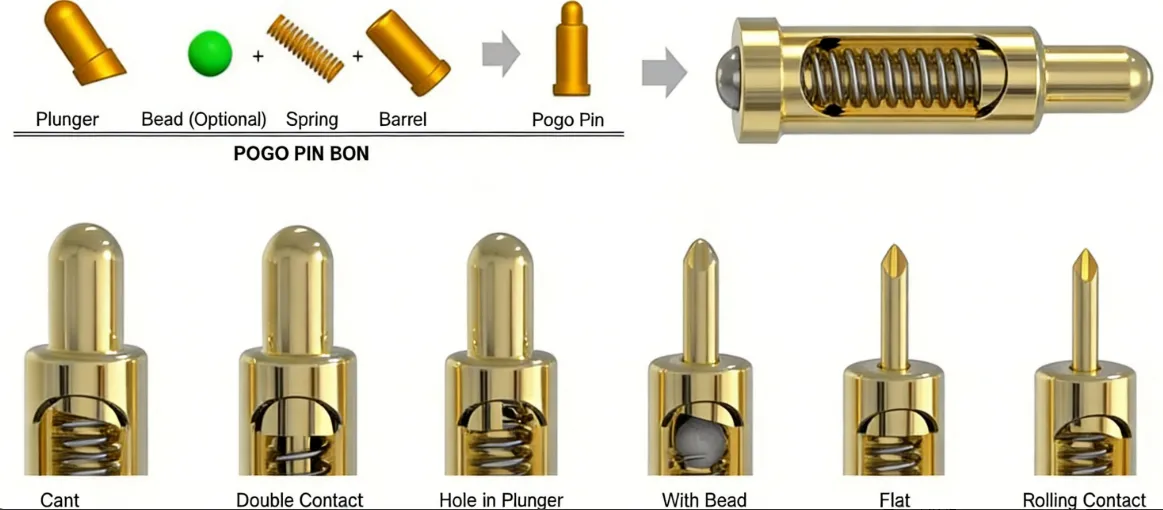
III. Solutions to Intermittent Contact Failure in Pogo Pins
Select a pogo pin with a working height that is compatible with the product’s connection spacing, ensuring that the pin does not operate under conditions of excessive overload or insufficient normal force.
Based on the product’s application environment, choose an appropriate surface plating treatment for the pogo pin. For products that come into contact with skin, consideration should be given to whether the plating layer meets biocompatibility requirements to avoid causing skin irritation or allergic reactions in users.
For contact issues arising from circuit design, adjust circuit parameters—such as voltage and current—as needed to prevent contact failure in pogo pins.