
Decoding the Three Core Applications of Pogo Pins in AR Glasses: The Key Roles of Magnetic Charging, Modularization, and Internal Connectivity
1. Intelligent Charging and Data Transfer Hub
Modern AR glasses commonly utilize magnetic charging interfaces, the core of which is precisely Pogo Pin technology.
Typical AR glasses charging interface configuration:
Power Transmission: 2-3 Pogo Pins are responsible for power delivery (5V/1.5A-3A).
Data Synchronization: 1-2 Pogo Pins are used for high-speed data transfer (USB 3.0+ standard).
This design not only achieves a “snap-to-charge” convenient experience but also ensures simultaneous firmware updates and data syncing during charging, significantly enhancing user experience.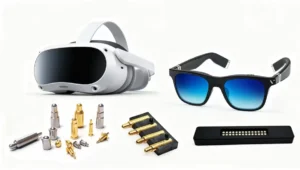
2. Critical Enabler for Modular Design
High-end AR glasses are trending towards modular designs, allowing users to replace battery, camera, or sensor modules. Pogo Pins provide the perfect solution in this scenario:
Plug-and-Play Experience: Module replacement requires no tools; connections are automatically established via Pogo Pins.
Fool-Proof Design: Specific pin arrangements prevent incorrect connections.
High Durability: Capable of enduring tens of thousands of insertion/extraction cycles while maintaining stable performance.
3. Invisible Bridge Between Internal Components
Even within the interior of AR glasses, Pogo Pins play a vital role:
Connecting the display module to the main circuit board.
Bridging various sensors (gyroscope, accelerometer, ambient light sensor).
Enabling electrical connections for adjustable nose pads or temple arms.